
- August 13, 2026
- 35
New Voices on the Trakai District Issue: We Asked the Ministry About Taking Over a Polish School
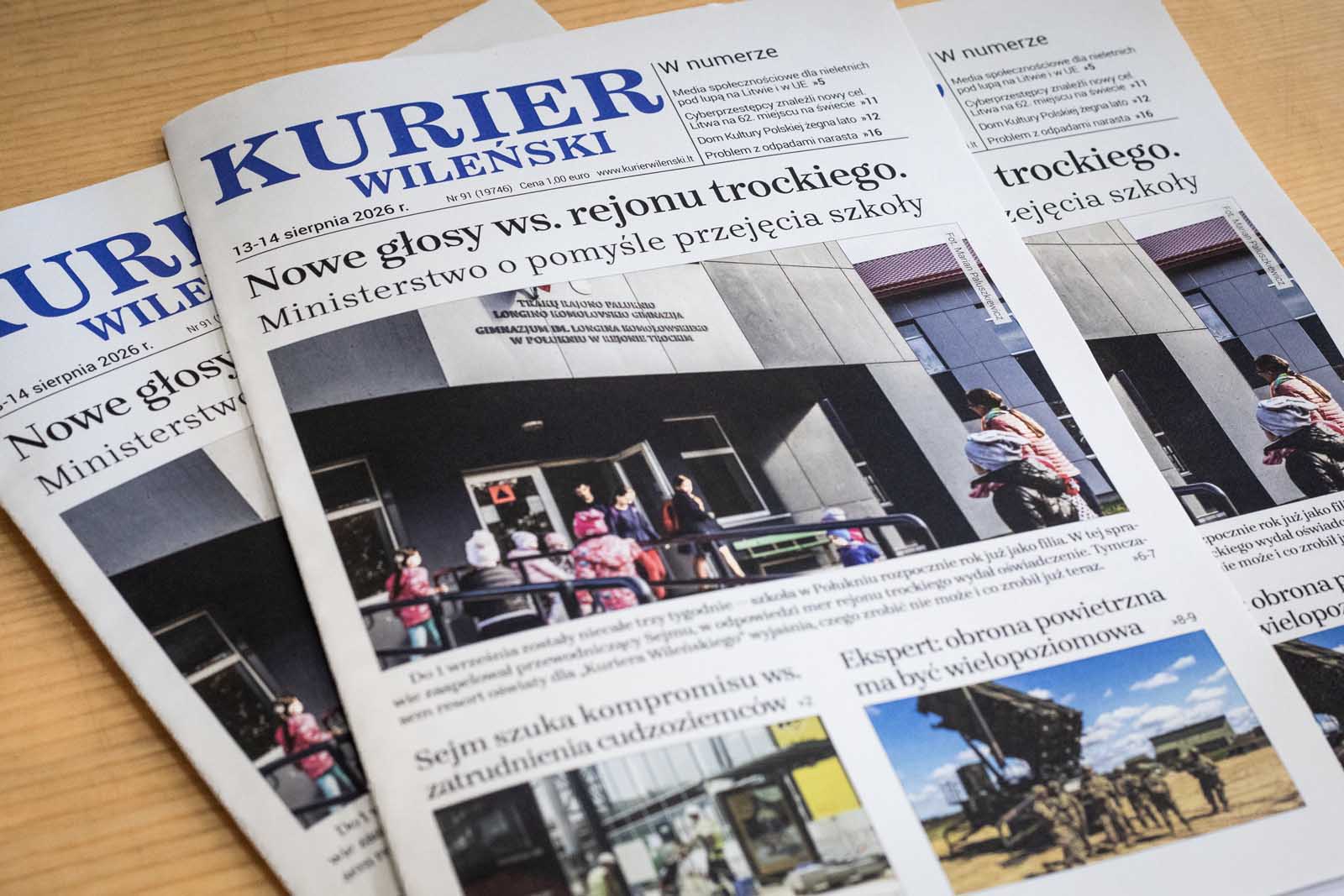
There are less than three weeks left until September 1 — the school in Paluknys will start the year already as a branch. The Speaker of the Seimas made an appeal on the matter, and in response the mayor of the Trakai district issued a statement. “Kurier Wileński,” meanwhile, submitted an inquiry to the Ministry. The Ministry explains what it cannot do and what it has already done. This is, however, yet another episode in a case for which time is running increasingly short.
Olekas’s appeal and Šatevičius’s response
The case of the Polish schools in the Trakai district has drawn new voices. First, the Speaker of the Lithuanian Seimas, Juozas Olekas, made an appeal calling on the Trakai district to reconsider the matter of the Polish schools within its municipality.
Following Olekas’s appeal, the mayor of the Trakai district, Andrius Šatevičius, issued a statement. In it, he claims that the Trakai district had already proposed to the government earlier that it take over management of the schools, “if the state believes they should remain independent” (i.e., not as branches of other institutions). The statement was also quoted by Lithuanian media.
Indeed, such a proposal was publicly announced by the district as early as February of this year, when Šatevičius stated in the media that the state could take over these schools “if it is a matter of security or foreign policy.” In his new statement, the mayor claims that the district “has not received any concrete proposals.”
Not everything is so simple
The mayor’s statement also contains certain omissions — the mayor briefly states that “there were discussions” with the school community. However, that same school community emphasizes the lack of dialogue, a bulldozer-style approach to the matter, and being presented with a fait accompli.
The mayor also stresses that, in light of the district’s proposal for the state to take over the school, “it is improper to encourage the municipality to reconsider decisions taken in accordance with the rule of law.” However, the “lawfulness” of these decisions is called into question by the report presented during a conference by the European Foundation of Human Rights (EFHR) and the Vilnius Forum.
The report argues that the decisions adopted by the Trakai district municipality may violate the law of the Republic of Lithuania as established by the Seimas, and even the Constitution of the Republic of Lithuania and international agreements.
Possible segregation in the district
According to the EFHR report, the Trakai district may be experiencing the harshest form of discrimination — segregation — where a Polish school, having met the same qualitative and quantitative conditions as a Lithuanian school, loses its independence and is downgraded to a branch, while the Lithuanian school retains its status.
The same conference on the report was also attended by the school community from Paluknys and a delegation from the Ministry of Foreign Affairs of the Republic of Lithuania, so it can be assumed that the ministry is aware of the matter. On the other hand, despite invitations, there were no representatives of the Electoral Action of Poles in Lithuania – Christian Families Alliance, which is currently part of the ruling coalition, including the party’s Minister of Justice, Rita Tamašunienė.
What solutions exist for the school?
In July, the Editorial Board of “Kurier Wileński” addressed the EFHR report on Polish schools in the Trakai district. It proposed that the government take over the school under its own authority in a situation where the district authorities see no possibility of preserving the school’s status.
As the editors noted, there is precedent in the Republic of Lithuania for the state taking over schools. This is how, for example, the Millennium Gymnasium in Šalčininkai operates, in the Šalčininkai district, which is nearly 80 percent inhabited by Lithuanian citizens of Polish nationality.
The Ministry of Education’s response
“Kurier Wileński” asked the Ministry of Education, Science and Sport of the Republic of Lithuania whether it plans to take over the Longinas Komołowski Gymnasium in Paluknys. We referred to the example of the Millennium Gymnasium in Šalčininkai, which is a ministerial school, not a municipal one.
“The reorganization of the school network cannot take place without consultation with residents. (…) It is unfortunate that this matter has been dragging on for so long, and the community’s expectations continue to be ignored,” the Ministry of Education commented to “Kurier Wileński.”
The Ministry does not plan to take over the school
As we have learned, the Ministry is not considering taking over the school. It states that this is not permitted under the Law on Local Self-Government and “other legal acts.”
“The Ministry of Education, Science and Sport is not currently considering taking over the school — this is not permitted under the Law on Local Self-Government and other legal acts. The Millennium Gymnasium in the Šalčininkai district is a state school, established in accordance with the Law on Education, which provides for the establishment of state schools in fulfillment of the state’s obligation to ensure access to education in the state language throughout the entire territory of Lithuania. At the Longinas Komołowski Gymnasium in Paluknys, instruction is not conducted in the state language,” “Kurier Wileński” was told.
The Ministry also cites declining student numbers.
“The school network in the district is managed by the municipality, based on criteria set by the government. As the number of students in the districts decreases, so does the number of schools — this also applies to schools where the language of instruction is Lithuanian. Ministry staff have repeatedly met with the Paluknys gymnasium community and the municipality to hear all the arguments. Our goal was to help find a solution that would meet the community’s expectations, preserve its trust, and ensure the best possible educational opportunities for the children,” the Ministry states.
“We amended the regulations”
The Ministry also referred to changes it had already introduced on August 12.
“The Ministry also proposed another possible solution. We amended the regulations on the school network — from September 1, in gymnasiums in the Vilnius, Šalčininkai, Trakai, and Švenčionys districts conducted in a national minority language, as well as in Lithuanian-language gymnasiums if they are the only ones in a given area, the number of students in the final grades may be reduced from 12 to 8 starting in September, and the total number of students in the school may be fewer than 60. However, the decision on this matter remains within the municipality’s authority. Today, August 12, the government approved changes to the school network,” the Ministry explained to us.
“We emphasize that decisions regarding the network of municipal schools are made by the municipal council, in accordance with the Law on Education, the Law on Local Self-Government, and the school network formation principles approved by the government,” the Ministry states, thereby passing the matter back to the Trakai District Municipality.
Further in its comments, the Ministry noted that the overall school reorganization plan must be subject to public discussion. According to “Kurier Wileński’s” information, no specific figures have been presented regarding how much money the municipality would save by reorganizing the Longinas Komołowski Gymnasium in Paluknys.
Has the time to react already run out?
The school’s reorganization became a reality this summer. The former director of the gymnasium, Renata Krasowska, pointed out what the EFHR report had already shown earlier — that Lithuanian schools (for example, in Onuškis, in the same Trakai district) can retain their status even with fewer students, while Polish schools, such as the gymnasium in the aforementioned Paluknys, cannot.
What happens next with the school’s case? Less than three weeks remain until the start of the school year. The school in Paluknys no longer has independent status, and its director has been dismissed. If the Council of the Trakai District Municipality is to make a decision in accordance with the regulatory changes introduced by the Ministry of Education, Science and Sport on August 12 — the council session has not yet been announced, but it customarily takes place in September, after the summer break. The matter therefore remains open despite the approaching September 1 deadline.
What does Polish diplomacy say about this?
Polish diplomacy had earlier emphasized, on the occasion of the June conference held by the Vilnius Forum and the European Foundation of Human Rights, that the issue of the schools “is above all an internal matter of the Republic of Lithuania,” expressing understanding for “the rather complicated system of education management, as in every country.” However, it also warned of an approaching crisis.
“And I would very much not want something similar to suddenly start happening in Polish-Lithuanian relations [as in Polish-Ukrainian relations — ed.]. Some of you probably know the concept of ‘the weakest link.’ We know how much connects Poland and Lithuania. How many common challenges we share. We also know who benefits from us quarreling, from something going wrong between us,” said Dariusz Wiśniewski, Consul General of the Republic of Poland in Lithuania, in June.
“But I’m afraid that without political engagement at higher levels, this could be very difficult,” he added, though he expressed hope that this could be prevented.
Can an uncontrolled deterioration of Polish-Lithuanian relations and a crisis still be avoided at this point? At this stage, it is impossible to predict.
Translated by Zuzanna Biśta within the framework of a traineeship programme of the European Foundation of Human Rights, www.efhr.eu.