
- May 24, 2026
- 309
Education Conference of the Association of Polish School Teachers in Lithuania “Macierz Szkolna”: “We Are Not Protesting Against Something or Someone”
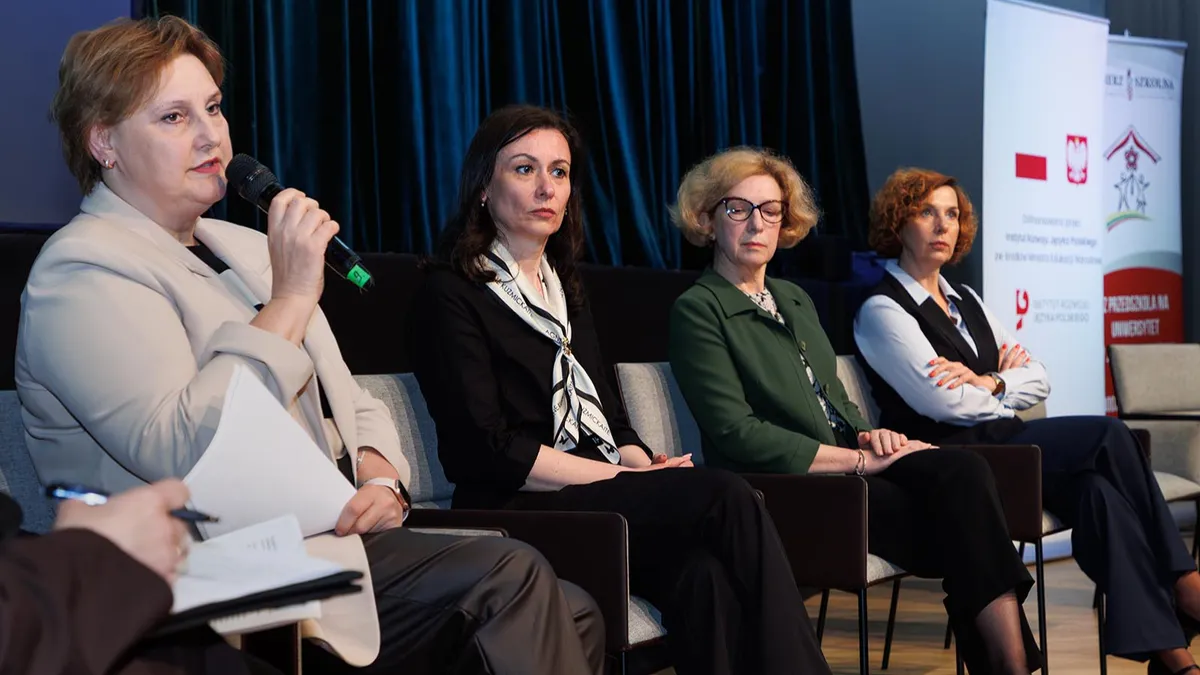
At the Conference convened by the “Macierz Szkolna” Association a resolution concerning the Polish schools in Lithuania was adopted, to be addressed to the authorities in Lithuania and Poland. “This is our stance on what we expect from the Lithuanian authorities” says Krystyna Dzierżyńska.
The Association of Polish School Teachers in Lithuania “Macierz Szkolna” organized a working conference titled “Polish Education in Lithuania Facing New Challenges” at the House of Polish Culture in Vilnius. “We want to determine our position regarding class formation, the training of Lithuanian language teachers, and the preparation of textbooks for learning Lithuanian. We’re constantly being told that we don’t want to learn Lithuanian. That’s not true. We do want to learn, but we’re constantly calling, for these additional hours not to be added mechanically. It’s just a matter of preparing the right materials, so that the Lithuanian language teacher does not have to use photocopied worksheets for students” Krystyna Dzierżyńska, president of the “Macierz Szkolna” Association told reporters about the conference’s purpose.
Level of support
Representatives of the St. Maximilian Maria Kolbe Institute for the Development of the Polish Language were present at the conference. “I am very pleased to be here with you, to listen to the discussions taking place, and that we can hear directly from you about the Polish educational community in Lithuania. It is a very unique community, especially in terms of its scale, evidenced by the number of people present in this hall. This is also evidenced by the level of support the Institute provides for the needs of Polish education in Lithuania, which was approximately 6 million zlotys last year” – said Izabela Siekierska-Rosiak, Head of the Institute’s Department of Strategy and International Cooperation, as she welcomed the attendees. The inaugural lecture was delivered by Prof. Przemysław Gębal, Ph.D., an expert from the Institute for the Development of the Polish Language.
Adoption of a resolution
The working conference of the “Macierz Szkolna” Association adopted a resolution emphasizing that the conference focused primarily on systemic, legal, and structural problems in the Polish education system in the Vilnius region. The authors of the resolution emphasized that these problems are essentially caused by “successive stages of educational reforms and the forced implementation of changes in national minority schools in Lithuania.”
The document states that “the international documents ratified by the Republic of Lithuania- in particular, Articles 12-14 of the Framework Convention for the Protection of National Minorities and Article 14 of the Treaty between the Republic of Poland and the Republic of Lithuania on Friendly Relations and Good-Neighborly Cooperation- guarantee national minorities the right to preserve their national identity, learn their native language, and receive education in that language, and new legal acts must not impair the acquired rights of national minorities.”
“The Conference emphasizes that the Polish school in Lithuania constitutes an asset for the entire Republic of Lithuania as an example of multilingual, multicultural and civic education. National minority education does not pose a threat to national integration but strengthens civic bond with the Republic of Lithuania” – as stated in the document.
Language as a foundation
The resolution emphasized that the “Macierz Szkolna” Association advocates for preserving tradition of Polish schools, calls for the creation of a permanent mechanism to protect education and highlights that “the Polish language is the foundation of the national identity of the Polish community in Lithuania.” “The Conference expresses the conviction that the further development of Polish education in Lithuania will make a significant contribution to building a modern, open, and socially cohesive Republic of Lithuania, based on mutual respect, dialogue and regard for cultural diversity”- the authors state in the concluding section.
The issue of so-called school network optimization was also raised. “Emphasizes that the optimization of the school network must not be carried out to the detriment of children or in a manner contrary to the principle of universal access to education. When forming classes in Grades 1–10 in schools located in areas where Lithuanian-language schools operate alongside national minority schools, the requirement for the number of students should consider the specific nature of national minority school. In particular, the assessment of the efficiency of the school network should not be based solely on uniform quantitative criteria but should also take into account the actual demographic and linguistic circumstances”- the resolution highlighted.
Textbooks and programs
Krystyna Dzierżyńska emphasized that the Resolution reflects the stance of the teaching community at Polish schools in Lithuania. – It’s primarily about what we want, while also drawing attention to what we don’t like- says the president of the “Macierz Szkolna” Association. The resolution is to be presented to the Lithuanian authorities and forwarded to the authorities of the Republic of Poland.
-Perhaps even to a European Union institution. I would like to highlight that we are not protesting against something or someone. We simply express our opinion about what we expect. We expect that there will be no sudden changes that have not been discussed with our community. For example, someone decided that there must be more hours of Lithuanian language classes, but this hasn’t been accompanied by any action. After all, we’ve been asking for textbooks, teachers, and curricula for the Lithuanian language for many years- adds Dzierżyńska.
Translated by Małgorzata Wojnakowska within the framework of a traineeship programme of the European Foundation of Human Rights, www.efhr.eu.