
- September 23, 2026
- 125
More than politics. What actually threatens Polish education today?
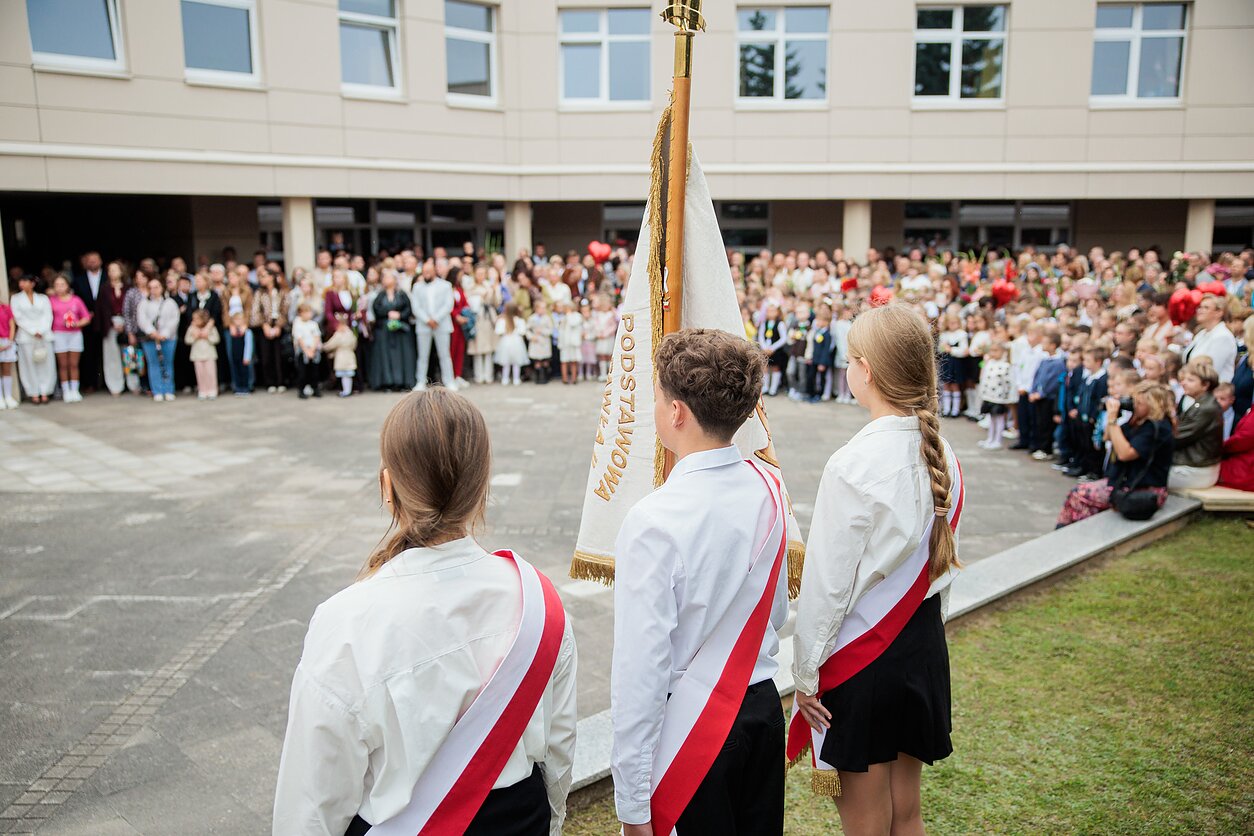
For many years the discussion about Polish schools in Lithuania was focused on protecting them from reorganization and institution shut downs, as well as from limiting the access to education in the Polish language. Today it seems that there is no direct political threat of dismantiling this system. However, there are other problems emerging: demographic issues, teacher shortage, uneven quality of education, competiton for students, and the question whether the current school system is going to keep working out for parents in ten or twenty years. Maybe the most difficult challenge in the future of Polish schools is not just protecting their existence.
According to the latest census, the Poles are the biggest national minority in Lithuania; in 2021 there was 183,4 thousand citizens of Polish ethnicity, which constitutes 6,5% of the population. Among the youngest, between ages 0-9, the contribution of Poles is smaller – 5,3%. It is a clear sign that demography is going to become one of the most important factors in the future of education.
In the summer of 2026, the Ministry of Education stated that in 5 municipalities there were 59 schools that offerred Polish as the language of instruction. This year’s “Bon for first-grade pupils” included 848 first-graders in 48 Polish schools. In Vilnius, 6% of all students attending municipality schools takes classes in Polish as a language of instruction.
On first glance, talking about the collapse of the system seems to be an exaggeration.
But there are other statistics.
Polish schools in Lithuania through the lens of PISA
According to the PISA 2025 study results announced in September, Lithuanian 15-year-olds gained 488 points in Science, 470 in Mathematics, 464 in Reading and 512 in a new domain – Computational Problem-Solving. The points scores across all four domains were higher than the OECD average, but in case of Reading the advantage of three points was not significant. Lithuania scored the most in Computational Problem-Solving.
If we compare it with the scores of schools with other languages of instruction, the situation looks much less optimistic. Across all four domains that were studied, the lowest average scores belonged to Polish-language schools. In Science it was 441 points, compared to 490 in Lithuanian schools and 485 in Russian ones. In Mathematics – 433, 472 and 466, respectively. In reading 410, 466, 463. And in Computational Problem-Solving 485, 513, 511.
It indicates that the difference between the students of Polish and Lithuanian schools is 49 points in Science, 39 in Mathematics, as much as 56 in Reading and 28 in Computational Problem-Solving. 708 students from 36 Polish schools participated in the study.
These numbers are grave enough that they cannot be ignored. But at the same time, they do not provide the answer as to why these differences are so vast. PISA reveales correlations between different factors, though it does not prove that the language of instruction is the cause of the problem. The study itself also displays a strong diversity of scores depending on the place of residence or socio-economic status of students – schools in big cities usually obtain higher average scores than smaller towns. Pupils from better socio-economic environments tend to outperform others.
Based on these results, it’s easy to form a politically appealing theory: more Lithuanian and less Polish in schools, and the problem will be solved. But PISA statistics do not allow such a simple conclusion. They show something much more uncomfortable for Polish education: there is a problem of quality and it cannot be hidden behind the right to instruction in the mother tongue.
Education, however, is much more complex.
A study published online in 2024, which in 2026 was included in the „International Journal of Comparative Sociology”, based on statistics of PISA 2018 concerning Lithuania, shows another side of the problem. The students of national minorities were achieving better results when their language of instruction was the same as the one they used at home. The authors emphasize that the previous studies do not give an unequivocal answer as to whether minority schools perform better or worse than Lithuanian ones.
So the question is not simply: in what language should they study?
It’s a much harder one to answer: how to build a good Polish school?
„I love and I embrace”
A couple of years ago, the discussion regarding Polish education was dominated by one question: will Polish schools survive another reform? Today the situation became much more paradoxical.
Laurynas Kasčiūnas, the leader of the conservatives, proposes a fundamental change in the model of Russian-language schools. According to his project, since 2030, all subjects in said institutions, except for mother tongue, should be conducted in Lithuanian. Polish schools were excluded from these changes.
In interview with LRT.It Kasčiūnas stated that he does not plan to impose these reform on the Polish minority and that any future changes within Polish institutions should progress “naturally”. After that, he gave an argument that goes far beyond educational matters: Poland is a strategic partner for Lithuania and starting yet another conflict with Warsaw is not in the best interest of the country.
Talking generally about Lithuanian national minorities he clarified that they are citizens of Lithuania that he “loves and embraces”.
Political scientist and professor at the Institute of International Relations and Political Science of Vilnius University Mariusz Antonowicz points out another side of this provision.
– It is both reassuring and worrying. Reassuring, beacuse relationship with Poland is important to the government. On the other hand, it shows that Lithuanian Poles are treated more as objects and not as subjects.
In his opinion, the problem appears when the right to education in Polish is not justified by the presence of a national minority in the country, but by the need to keep good relationships between Vilnius and Warsaw.
– If Presidents or Ministers of Foreign Affairs were to argue, everything may change. – Antonowicz points out.
Antonowicz finds the lack of subjectivity as the fundamental problem of Polish education. On one hand the schools are a topic of discussion between Vilnius and Warsaw, on the other hand political parties for years have been mobilizing their voters to protect them. The community itself seldom tries to figure out what kind of system do they want to have in ten or twenty years.
– We know that we are going to encounter demographic issues. We know there will be a shortage of teachers. The question is: what can we do and how can we change that system? – says Antonowicz.
„Distrust which halts the change”
Mariusz Antonowicz has been criticizing the politicization of Polish education for many years. He once spoke about schools being treated by Electoral Action of Poles in Lithuania – Christian Families Alliance (AWPL – ZChR) as partisan strongholds. Today he sees the problem in a broader context: in his view, Polish schools got stuck between the distrust toward the state of Lithuania and the conviction that every change means concession.
The political scientist also takes notice that the current model is not the only one that is possible. Bilingual schools, institutions with different language streams or systems where early education remains close to home while older grades are more centralized – all of these solutions function in other countries.
Lack of ideas is not the issue here.
– We can come up with many alternatives. The thing is that the distrust between parents, teachers and the Lithuanian government is so profound, that there is virtually no place for dialgue – Abramowicz states.
– One side argues: there are demographic problems so we should close down. But the other one responds: no concessions. Then the first stage take the costs of maintenance, job positions, just to upkeep the buildings. While all the other issues are being pushed aside. – explains Abramowicz.
In his opinion, the permanent sense of danger makes the conversation even more difficult.
– It’s just exhausting and it doesn’t produce any solutions. People are not even looking for solutions because of the lack of trust. – Abramowicz summarizes.
“There’s no point in defending every institution”
Robertas Duchnevičius, the Mayor of the Vilnius Region, looks at the problem from a different perspective. The Municipality should make the final decision about each particular school; whether to expand it, merge it with another institution, open a new language stream or create a bus connection for students that would take them to school directly.
In the Vilnius Region the demographic situation is not similar to the classical tales of depopulating villages. On the contrary, the suburban towns are growing. New families keep arriving – mostly Lithuanian-speaking. Therefore, the demand for Lithuanian schools is growing.
Does it mean that Polish schools are being slowly driven to extinction?
Duchnevičius gives an example of Avižieniai, where one gymnasium provides education in both Polish and Lithuanian at the same time. Even though the number of Lithuanian-speaking inhabitants is incresing, there is also a growing amount of students in grades with Polish as the language of instruction.
For the Mayor, the conclusion is simple: if a school is attractive, its language is not necessarily going to determine its failure.
For that reason, he doesn’t find any one solution for the entire region. In some places we need to build new schools, in others we can consider opening bilingual grades. In areas affected by a shortage of students, instead of upkeeping a couple of small schools located close to each other, it would be better to create one, solid institution and provide pupils with means of transportation.
Kindergarten and elementary school should remain as close to home as possible. The older grades, however, can be centralized. We need to protect institutions that are already strong, instead of artificially saving schools where there’s no children.
That is a major change. In traditional political narrative, success is defined by keeping a school from closing down. According to this logic, a success means that a child can still get a full education in Polish on a solid level – even if it is going to happen at a different building.
Paluknys and the “Pandora’s box”
Today, this contradiction is best observed in Paluknys.
Former Longin Komołowski Gymnasium was merged with another institution after reorganization. There are barely more than 80 students, and only four started the first grade. The Ministry is considering the school’s takeover by the state.
Kasčiūnas admitted that from the point of view of optimizing the school net, efficacy and quality education, this solution is hardly logical. Simultaneously, he understands its “geopolitical logic”.
– The school discourse became a subject of discussion in the relationship between Poland and Lithuania and is now politically delicate. – the leader of the conservatives explains.
Duchnevičius makes an even stronger statement: the takeover of schools by the state may open the “Pandora’s box.”
It’s not because he finds the educational institution in Paluknys unncessary. On the contrary: in his opinion the gymnasium was weakend by the conflict inside of the Municipality, even though the Lithuanian school was operating in similar demographic conditions.
– The precedence is the problem. If every local political dispute is going to result in schools being taken over by the state, the system’s rules will blurr. In the event of conflict between politicians, the schools often end up as hostages.
In August, the government loosened the cirteria for national minority schools in four regions. Since September, in certain cases, the grades third and fourth of Gymnasium will be allowed to operate with the minimal student threshold of eight pupils, instead of twelve. The threshold for an entire school was lowered below 60.
The state is already paying extra to keep calculations from being the only criteria. A question remains: where to draw the line?
“A Polish school needs to be a good school”
Adam Błaszkiewicz, the principal of John Paul II Gymnasium in Vilnius, doesn’t accept a simple claim that Polish schools, as a part of minority’s heritage, should be just kept afloat.
– Polish school should be a good school with high achievements, so that parents will choose it willingly. Concurrently, I expect the state to recognize that Polish community is a native minority, not a group of immigrants. The possibility of completing full education in their own language is a value in itself. – he says.
His gymnasium operates in a different environment than small town institutions – it competes for students with top schools in Vilnius.
Błaszczkiewicz thinks that the same mindset should be applied outside of the capital.
– We need to ensure that Polish schools are able to compete with other institutions in a given area, or surpass them.
This may be the most uncomfortable opinion in the debate. If we were to take it seriously, then a Polish school cannot demand from parents to choose it in the name of protecting idenitity only. It needs to give a child equal opportunities as another school nearby.
He doesn’t agree that increasing the amount of subjects taught in Lithuanian is going to resolve anything. More class hours of Lithuanian will not provide any solution.
– If students are to know the state language, they should prepare teachers to teach Lithuanian as a language that the child doesn’t use at home, create adecuate textbooks and methodology. – states the principal.
He draws a firm line:
– If there’s a school with Polish as the language of instruction, then Polish, not any other, must be its language of instruction.
Switching to instructing more subjects in Lithuanian may deteriorate the knowledge of Polish specialist terminology, and it doesn’t automatically guarantee better results.
Support from Poland – but what’s next?
For Polish schools in Lithuania, Poland is more than just a political point of reference.
For Adam Błaszkiewicz, principle of John Paul II Gymnasium in Vilnius, its importance is very clear:
– The practical experience so far demonstrates that the support from Poland makes us look quite strong. We get good results, our schools are well-equipped. If we were to eliminate the help from Poland and rely solely on Lithuanian funding, I’m not certain that we’d be able to remain competitive.
This support helps schools keep their educational level and invest in equipment, but Błaszkiewicz warns that external allies won’t guarantee the future of Polish education.
In his opinion, Polish community must actively fight for their best interest and pay attention to the actions of politicians, and not just their declarations.
– We need to be active, negotiate, reach conclusions and not wait for somebody else to solve our own problems. I wish Polish school motivated students. Because its future will not be decided only by politicians, demography and further reforms, but mostly by the community itself – depending on its awareness of its own needs, its readiness to take on responsibility and ability to think about the future. – summarizes Błaszkiewicz.
Translated by Oskar Szperna within the framework of a traineeship programme of the European Foundation of Human Rights, www.efhr.eu.