
- October 28, 2026
- 39
Vilnius to commemorate Polish artists, but Polish-language inscriptions will be missing
Vilnius to honor Polish artists, but Polish-language inscriptions will be absent
On the initiative of the local government of Vilnius, a growing number of red plaques commemorating its prominent residents are appearing across the city. This time, the city authorities have decided to honor Józef Czechowicz, as well as Wincenty and Ludomir Śleńdziński.
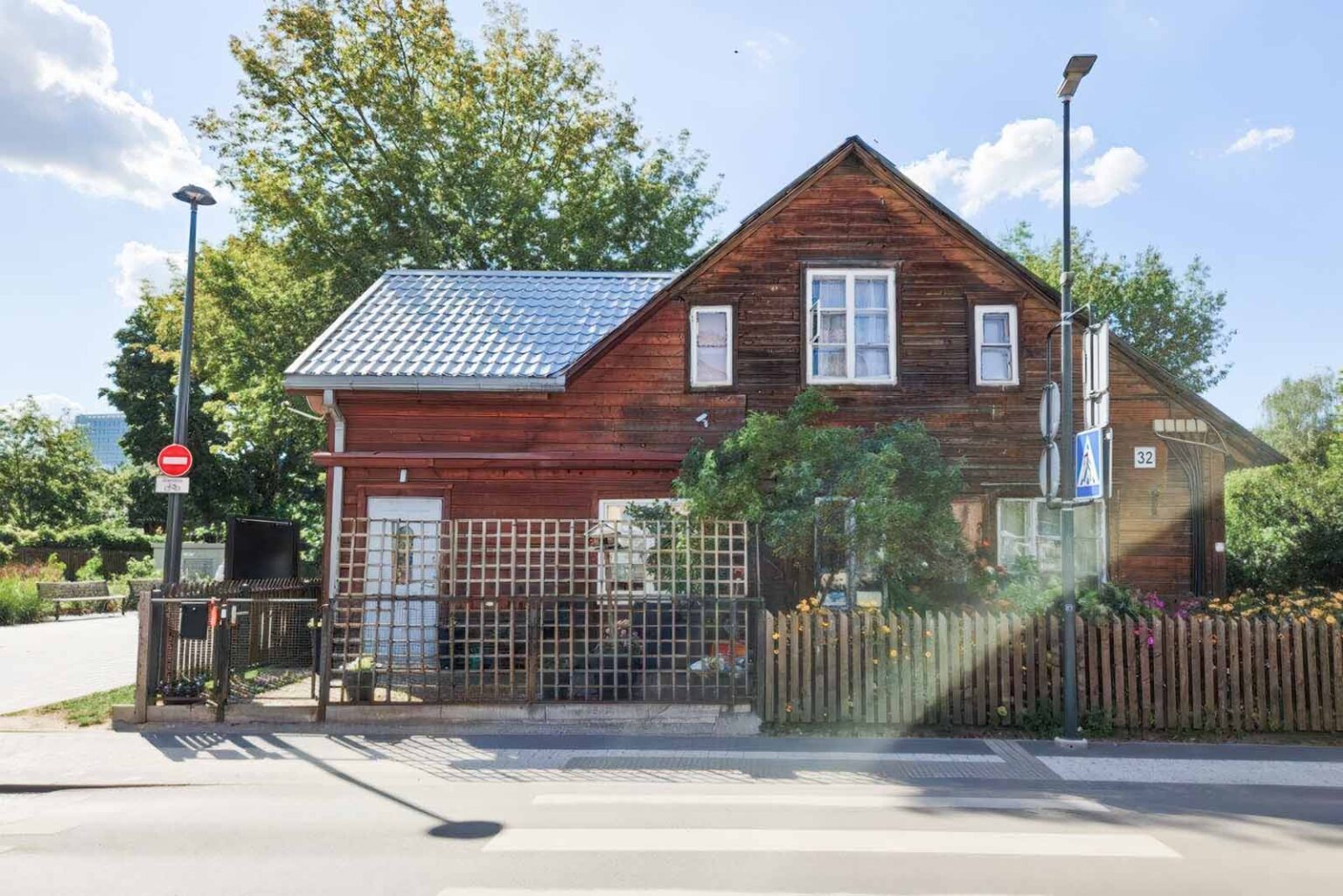
Lithuanian-language plaques commemorating a distinguished Vilnius photographer and painters are to be placed on the wall of a wooden house at 32 Giedraičių Street.
Not only are Polish artists the ones to be honored, but also the house itself, which has an extraordinary history.
“It is widely known that Vilnius is a city remarkably rich in historical as well as cultural heritage. It is impossible to understand the city without including the multi-century presence of Poles and their crucial involvement in forming its identity. The heritage of our city is not a collection of separate national histories, but a common legacy of generations of people who, throughout the centuries, have been creating Vilnius. The recognition of Polish involvement enriches this understanding and may have a special meaning for contemporary Vilnius, in which Polishness is a vivid part of everyday and social life. Poles are not only the guardians of historical memory but also co-authors of the present and the future of the city; therefore, a tribute to prominent Poles ought to be a natural part of it. The power of contemporary Vilnius lies in its wealth of traditions, which created its identity. The history of the city reminds us that despite our differences, we have been creating the very same Vilnius throughout the generations” Edward Trusewicz, Vice President of the Association of Poles in Lithuania and Vilnius City Councilor, told Kurier Wileński.
Voting on the plaques
However, what raises questions is the fact that the plaques honoring prominent Polish artists, whose legacy is a notable part of the historical and cultural heritage of Vilnius, are to be written only in Lithuanian by the decision of the Vilnius City Council. It is natural that a question emerges as to whether the commemoration of people who have been creating the multicultural identity of the city shouldn’t also include the Polish language – the language associated with their life and work. As Edward Trusewicz emphasizes, since the legacy of Vilnius is a common effort of generations, and Polishness continues to be a living part of the contemporary city, wouldn’t the presence of the Polish language on the plaques dedicated to Polish artists be a fuller expression of recognition for our common history?
Despite the absence of the EAPL-CFA councilors during the vote, which took place on October 21, the Vilnius City Council decided to install memorial plaques in the Lithuanian language.
“The councilors weren’t present at the sitting for a completely different reason. During the consideration of the 18th item on the agenda, opposition councilors, including representatives of the EAPL-CFA, walked out of the session hall in protest against amendments to the Rules of Procedure of the Vilnius City Municipal Council pushed through by the ruling coalition. The proposed draft included provisions that would lead to a significant restriction of councilors’ rights, particularly their ability to submit draft resolutions and take the floor during their consideration. In practice, it would mean that the ruling majority could decide not only on the result of the vote, but also whether a councilor would get an opportunity to express their stance. It is hard not to notice a fundamental difference between the majority’s right to make decisions and granting it the ability to restrict the minority’s right to speak. We considered these proposals unacceptable in light of democratic standards of local government debate, so we requested that the draft be removed from the agenda. However, the ruling coalition decided by a majority vote to keep it on the session’s agenda. In this situation, the opposition councilors jointly decided to leave the chamber, thereby expressing their opposition to solutions that can hardly be described as anything other than an attempt to restrict the opposition’s voice. Since the issue of the plaques commemorating Czechowicz and the Śleńdzińskis was further down the agenda, our absence also extended to the vote on this matter,” Edward Trusewicz explains.
Jarosław Kamiński, Vilnius City Councilor representing the EAPL-CFA, emphasizes that he has been against the decision of the commission since the beginning.
“The Naming Commission made that decision without any consultation. Unfortunately, at present, the situation in the municipality is that any differing views on this issue are simply ignored,” the councilor commented.
At the same time, he notes that the Polish community can get involved in the matter. In his view, both Polish non-governmental organizations and individual residents who disagree with the city authorities’ decision can submit an application for the installation of bilingual Lithuanian-Polish commemorative plaques.
“After all, any municipal decision can be revised” Jarosław Kamiński notes.
The Chronicler of Vilnius
Józef Czechowicz (1818-1888) was a pioneer of Vilnius photography who was the first to capture panoramas of Vilnius and church interiors in photographs. His legacy comprises over 300 photographs and glass negatives depicting the city, its monuments, and its surroundings. The largest collection of Czechowicz’s works is preserved by the National Museum of Lithuania, which published an album dedicated to the photographer in 2016.
Czechowicz was born in the Vitebsk Governorate, in present-day Belarus, and learned the art of photography in Paris. Before settling in Vilnius, he traveled across the cities of the Russian Empire, photographing historical places along the way. He made a living primarily by taking portraits, running photography studios in Kyiv and Vitebsk, among other cities. In 1865, the artist moved to Vilnius, where he operated under strict government control.
In the beginning, he lived in rented apartments and houses, and in 1866 he settled in Antakalnis, where he established a photographic studio.
Two years later, Czechowicz signed an agreement with the City Duma to build a photography pavilion near the City Garden. A conflict with the city authorities arose when he erected a more permanent residential building that did not match the approved design. Moreover, its appearance resembled a rural cottage. The City Duma demanded the demolition of the building or the embellishment of its facade through the addition of architectural details. Eventually, the conflict was resolved, and Czechowicz obtained permission to run a photography studio, equipped with six cameras, in his house on Botaniczna Street (now Barboros Radvilaitės Street).
Following Czechowicz’s death, the photography studio was inherited by Anna de Rotte, his partner of many years. They had two sons, Antoni and Julian, and also raised Anna’s two children from her previous relationship – Regina and Maurycy de Rotte. Shortly after Czechowicz’s death, Anna married the well-known Vilnius painter Wincenty Śleńdziński. She continued to run the photography studio, using the name Anna P. Śleńdzińska.
After the lease expired, the building was relocated to Šnipiškės, to Chocimska-Chiwańska Street (now 32 Giedraičių Street).
The Śleńdzińskis – three generations of artists associated with Vilnius
Wincenty Śleńdziński (1837-1909) studied drawing and painting under the guidance of his father, Aleksander Śleńdziński (1803-1878), and the renowned artist Kanuty Rusiecki. His music teacher was Stanisław Moniuszko, a family friend.
Wincenty spent his childhood in Vilnius, in the home of his paternal grandfather, Marcin Śleńdziński, who served as mayor of the city. At that time, the Śleńdziński family lived in a townhouse located on the corner of Wielka Street (now 15 Didžioji Street) and Szklana Street (Stiklių Street). According to some sources, Adam Mickiewicz also visited there.
During his studies in Moscow, Wincenty Śleńdziński befriended Michał Elwiro Andriolli, best known for his extraordinary illustrations for Adam Mickiewicz’s Pan Tadeusz. Both took part in the January Uprising. After its fall, Wincenty was exiled deep into Russia, returning to his native Vilnius only in 1883.
Śleńdziński created genre paintings and portraits, and toward the end of his life increasingly turned to historical and mythological themes, depicting the history of Lithuania in a romantic, at times sentimental manner. “His canvases can be found in Vilnius churches,” writes Prof. Tomas Venclova in his book Vilnius: “Wilno. Przewodnik biograficzny” (Vilnius. Biographical Guide).
The artist died in Vilnius and was buried in Bernardine Cemetery, next to his father. His works are held, among other places, in the Wroblewski Library, the collections of the Lithuanian National Museum of Art, as well as in museums in Warsaw, Kraków, St. Petersburg, and Moscow.
Upon returning from Russia, Wincenty married the widow of Józef Czechowicz. Their son, the future painter Ludomir Śleńdziński, was born in Vilnius in 1889. He studied at the Imperial Academy of Arts in St. Petersburg.
From 1920, Ludomir lived in Vilnius, where he lectured at Stephen Báthory University and exerted a significant influence on the development of the local artistic community during the interwar period. He painted portraits and landscapes, created reliefs and busts, and also worked on interior decoration.
In 1931, following the famous flood, he documented in paintings the royal remains discovered in the cathedral crypts. After the war, he moved to Kraków, where he took up the position of professor of drawing at the Cracow University of Technology. His works are held in museum collections in many countries around the world.
The work of Aleksander, Wincenty, and Ludomir left a lasting mark on the culture of Vilnius. A special place of remembrance dedicated to this family is the Sleńdziński Gallery in Białystok.
The position of the capital’s municipality on this matter will be presented in upcoming issues of Kurier Wileński.
Translated by Karol Koprowski within the framework of a traineeship programme of the European Foundation of Human Rights, www.efhr.eu.