
- June 20, 2025
- 5215
Ministry of Education Holds Its Ground – More Lithuanian Language Lessons Ahead
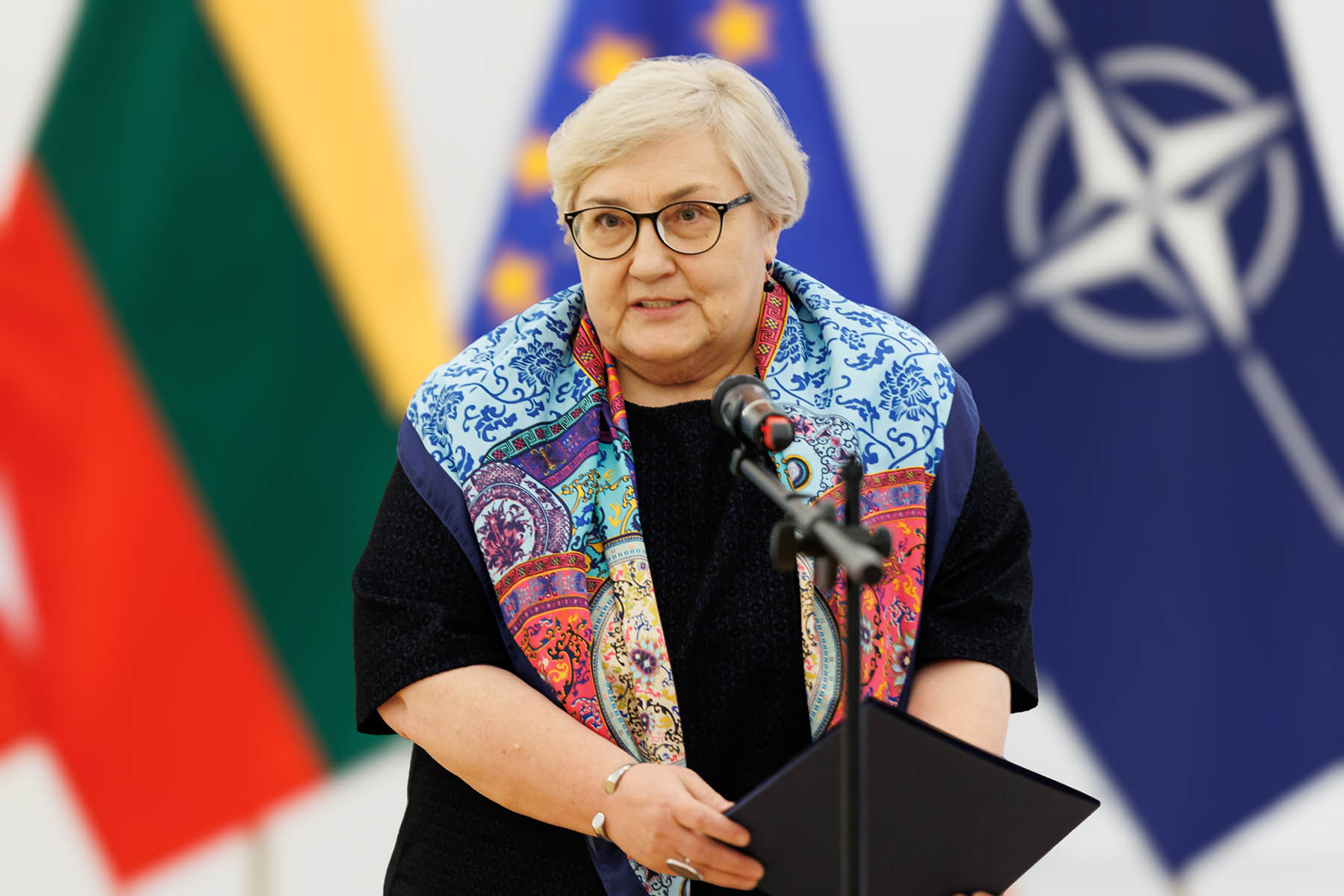
Plans by the Ministry of Education, Science and Sport to expand Lithuanian language teaching in national minority schools are facing unexpected challenges.
“We have submitted a letter to the Ministry of Health requesting permission to increase the number of Lithuanian Language Lessons for primary school students in national minority schools. The proposal involves adding one or several extra lessons per week,” said Raminta Popovienė, Minister of Education, Science and Sport. “We are asking for additional hours because it is impossible to expand Lithuanian language lessons at the expense of other subjects. Dance, music, art, and mathematics classes are equally important.”
Hygiene Standards Set Limits
Meanwhile, the Ministry of Health has stated that the number of daily lessons in early-grade classes is regulated by hygiene standards. Under current regulations, first-grade students may have a maximum of five lessons per day, students in grades 2 to 4 may have up to six, and those in grades 5 to 10 as well as high school grades I to IV may attend up to seven lessons per day.
The Ministry is currently reviewing the request and has announced that a decision will be made by the end of June.
Effective Teaching requires proper tools
Krystyna Dzierżyńska, president of the Association of Polish School Teachers in Lithuania “Macierz Szkolna,” says that simply increasing the number of Lithuanian Language Lessons will not solve the problem.
“In early March, the Ministry presented a draft curriculum plan for 2025-2026 and 2026-2027, which proposed increase in Lithuanian Language Lessons in grades 1 to 4 to seven or eight hours per week — a notable rise from the current schedule. At present, first graders have five hours, second graders four, and students in grades 3 and 4 five hours. Our educational community, including the board of ‘Macierz Szkolna,’ decided at a broad meeting with school principals that while the number of lessons should increase, it cannot be a sudden jump to seven or eight hours. We proposed increasing Lithuanian Language Lessons by one hour in early grades for the 2025-2026 school year, but we emphasize that more hours alone won’t solve the problem. This issue has been discussed for 30 years. The real solution lies in providing the right tools for teachers and students — proper curricula, appropriate Lithuanian language textbooks, and teacher training tailored to national minority schools. We believe that only after meeting these conditions the situation will gradually improve,” Dzierżyńska told Kurier Wileński.
No Changes Planned for Now
However, after a broad public discussion of the draft plan submitted by the Ministry of Education, Science and Sport, it became clear that there will be no changes in curricula.
“Minister of Education Raminta Popovienė approved the plan without increase in the number of Lithuanian Language Lessons in early grades at national minority schools. During the discussions, challenges emerged regarding the integration of subjects — Lithuanian cannot be taught at the expense of music, dance, or physical education classes. The Polish community also insisted that this must not come at the expense of the Polish language, their native tongue. For now, at least for the 2025-2026 school year, everything remains unchanged. However, the minister announced she will send a letter to the Ministry of Health requesting an increase in hygiene norms. This would mean raising the current 30-hour teaching limit in early grades by one or two hours, up to 31 or 32 hours per week. We are currently awaiting a response from the Ministry of Health. It is difficult to predict how the situation will evolve. At every meeting — both in the parliamentary education committee and in direct talks with Minister Popovienė — we have emphasized the need to prepare appropriate tools to help children from non-Lithuanian-speaking families and national minorities to start learning Lithuanian successfully. This would be a very good solution, because gradually increasing Lithuanian Lessons would certainly have a beneficial impact on the overall learning process,” our interviewee explained.
Standardization of the National Matura Exam
Data published by the Ministry of Education, Science and Sport shows that 20.4% of students in national minority schools failed the Lithuanian language and literature Matura exam, compared to just 6.7% in schools with Lithuanian as the medium of instruction.
“Of course, we cannot agree with the changes made in 2013, when the Lithuanian language Matura exam was suddenly standardized without wider consultations. At that time, the difference in teaching hours for this subject between national minority schools and Lithuanian schools was 850 hours, yet our students were required to take the same exam at the same level as their peers from Lithuanian schools. This is precisely why Matura results in national minority schools began to decline. However, this does not mean that students in minority schools were less diligent or motivated. The reason for that was this unfair standardization, which we, as the educational community, opposed.
It’s also inaccurate to say that Polish schools have low exam results. Some schools perform better, others worse. If we look at the overall results published by the magazine Reitingai, Lithuanian schools’ results in the Lithuanian language exam — which is their native tongue — are not very high either, though they do perform better than the national average.
To solve this issue, we need a comprehensive approach. We not only have to listen to to education experts who constantly introduce innovations, but also to teachers, students, and parents directly involved in the process,” emphasized Krystyna Dzierżyńska, president of the Association of Polish School Teachers in Lithuania “Macierz Szkolna.”
Krystyna Dzierżyńska also stressed that sudden changes in the education system should be avoided, as it requires careful consideration and stability above all.
Translated by Mateusz Chrapkowski within the framework of a traineeship programme of the European Foundation of Human Rights, www.efhr.eu.