
- March 1, 2026
- 13
Schools’ reorganisation or a step towards the dismantling Polish education in the Vilnius region?
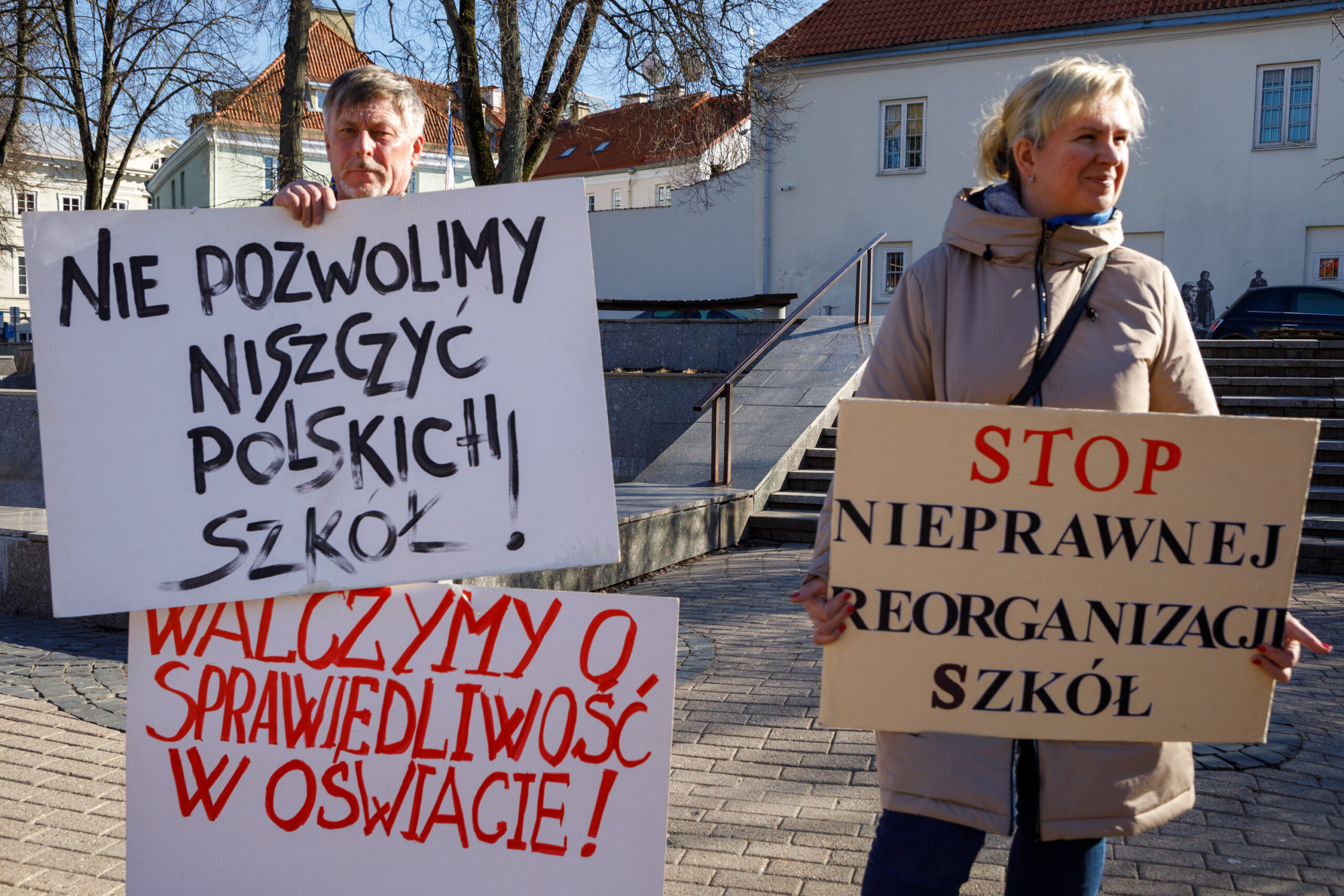
Schools’ reorganisation or a step towards the dismantling Polish education in the Vilnius region?
The reorganisation of Polish schools in the Trakai District, urged by the local government headed by mayor Andrius Šatevičius, includes the Andrzej Stelmachowski Primary School in Senieji Trakai and the Longin Komołowski Gymnasium of Paluknys. These institutions are being transformed into branches. The Polish community sees this as discrimination and the destruction of Polish education in the region.
The issue of the reorganisation of schools in the Trakai region has stirred up the Polish community. ‘It damages the image of our country, contradicts international agreements on national minorities, and violates the provisions of the Polish–Lithuanian treaty’, notes Krystyna Dzierżyńska, president of the The Association of Polish Schools Teachers in Lithuania ‘Macierz Szkolna’.
Meanwhile, Andrius Šatevičius, mayor of Trakai District, suggested that the Ministry of Education, Science and Sport take over the responsibility for these educational institutions. He justified this idea by referring to the pressure placed on local authorities and the local government’s inclination to ignore the law and keep the two Polish-language schools open.
According to the mayor, the decision to reorganise these educational institutions, taken back in 2022, caused enormous political pressure from various institutions.

The ministry is not considering the mayor’s idea
The reorganisation initiated by the Trakai District Municipality provides for the transformation of the schools into branches by merging them with the Trakai Gymnasium and the Henryk Sienkiewicz Gymnasium of Lentvaris, respectively.
‘Both the Ministry of Foreign Affairs and the Ministry of Education, Science and Sport are putting pressure on the local government and demanding that we change our decision on the reorganisation of the two schools. At the same time, there are all legal grounds to take these schools under state control if their independent maintenance is considered a national priority or a matter of foreign policy’, said Andrius Šatevičius.
He also announced that the local government had submitted a request to the Ministry of Education, Science and Sport, proposing to place the schools under the Ministry’s authority.
According to the response given to Kurier Wileński, the proposal of the mayor of Trakai District is not currently being considered. ‘The Ministry of Education, Science and Sport is not currently considering this possibility. The school network in the region is managed by the local government, based on criteria set by the government. As the number of students in the regions declines, so does the number of schools, including those with Lithuanian language of instruction. The language of instruction is not a criterion for managing the school network’, the response states.
‘The reorganisation of schools usually provokes a lot of discussion. We strongly encourage local authorities to reach a consensus with the local community in order to identify all the advantages and disadvantages of reorganisation. The rules for creating school networks stipulate that drafts of the general plan for the reorganisation of the school network and its annexes must be publicly discussed and agreed with the school communities. When a school becomes a branch, students and teachers continue to work in the same building, follow the same programmes and learn the same language; only the administration changes’, the ministry said in the statement.
Declining number of students
Mayor Šatevičius argues that the debate over the reorganisation of the two Polish-language schools has moved beyond the scope of local education policy and has become a national issue, with the local government being pressured to revise decisions adopted in accordance with the law.
He also emphasises that Polish-language schools are not being closed, but reorganised. What is more, this decision has been supported by the courts.
According to the mayor, the decision to transform the above-mentioned schools into branches was made due to the declining number of students and the increasing costs of maintaining these institutions.
‘In the case of the Longin Komołowski Gymnasium of Paluknys, the decision was dictated not only by the steadily declining number of students, but also by the objective possibilities of providing comprehensive education. In some years, there were only three to five students in grades 9–10, and merging classes is contrary to the applicable legal regulations’, Andrius Šatevičius assures us.
He claims that this situation meant constant financing of incomplete classes from the local government budget and limited possibilities for the full implementation of educational programmes.
There are currently 103 pupils at the Longin Komołowski Gymnasium of Paluknys, and the annual funding for this institution exceeds €1.09 million.
‘Due to incomplete classes and the maintenance of separate infrastructure, the local government incurs significant additional costs every year. We estimate that after the reorganisation, we will save approximately €160,000 per year, which can be spent on the needs of students and improvement of infrastructure’, argues the mayor of Trakai district.
He also emphasises that as part of the Millennium Schools’ Programme, educational institutions in the region currently receive approximately €2.5 million in funding. ‘Any changes to the plan threaten the loss of funding’, says the mayor of Trakai District.
Why Polish schools only?
Krystyna Dzierżyńska considers the reorganisation to be discriminatory against two Polish schools. ‘In general, I consider the whole situation concerning Polish-language schools in the Trakai District, namely the so-called reorganisation of Andrzej Stelmachowski Primary School in Senieji Trakai and the Longin Komołowski Gymnasium of Paluknys, to be discriminatory towards these two schools. A legitimate question arises: why Polish schools only? I do not think that decision-makers do not understand that this damages the image of our country, contradicts international agreements on national minorities, and violates the provisions of the Polish–Lithuanian treaty’, president of the The Association of Polish Schools Teachers in Lithuania ‘Macierz Szkolna’.
The mayor of the Trakai District, on the other hand, rejects accusations of discrimination against national minorities. ‘Decisions have not been and are not made on the basis of nationality or language of instruction. They are based on objective criteria: the number of students, the possibilities for organising teaching, legal requirements and responsibility for the stability of the education system throughout the district. Education in Polish is guaranteed, and the funds saved after the reorganisation will be invested in the needs of the students of these schools and in infrastructure’, emphasises Andrius Šatevičius.
A step towards the dismantling of Polish education
‘Looking back over the past years, we can say that such a reorganisation is a step towards the liquidation of these schools in the near future, regardless of the fact that they are left as functioning branches. We have examples from previous years when, out of seven functioning Polish schools, only two secondary schools and two (current) branches remained in the Trakai region after the transformation into branches. Moreover, Trakai District has a sizeable Polish minority population that contributes to the local budget and is entitled to expect that its interests, particularly in the field of education, be protected. Therefore, I consider it inappropriate for the founding authority to casually propose transferring the institutions it established to the Ministry of Education, Science and Sport. The ministry’s statements do not seem to indicate any willingness to take such steps. I believe that the mayor should show empathy, seek and find a solution that would be in line with the expectations and aspirations of the entire local community. Therefore, there is no reason to be offended that parents are fighting for their rights in court. On the other hand, the mayor’s recent statement saying that ‘the funds saved through the reorganisation will be invested in the needs and infrastructure of the students of these schoo
ls’ prompts the following reflection: if we want to invest in needs, then perhaps it is not worth reorganising and demolishing, but rather, on the contrary, we should provide real support for activities if they are for the good of the pupils of these schools’, comments Krystyna Dzierżyńska.
The fight to preserve the school continues
‘First of all, as residents of the Trakai region and representatives of the largest national minority in Lithuania, we are very appalled that in this discussion we are we are being portrayed as a problem, a source of pressure, or a burden. We get the impression that the Polish community is an obstacle for the local authorities, – one that can be most easily shifted elsewhere. We feel unnecessary, marginalised and even, in a sense, orphaned in this situation. Local government should serve all its residents, regardless of their nationality or the language of instruction in their schools. Meanwhile, there is a feeling that instead of dialogue and a joint search for solutions, a formal “transfer” of responsibility for our schools is being proposed’, says Renata Krasowska, head teacher of Longin Komołowski Gymnasium of Paluknys.
She does not believe that some schools should be under the supervision of the Ministry of Education, Science and Sport of the Republic of Lithuania, while others should be under the supervision of local governments. ‘The same model of education system management should be applied. Whether the mayor of the Trakai District has officially made such a proposal or only declared it verbally should be asked directly at the Lithuanian Ministry of Education, Science and Sport. We do not question the right of local authorities to reorganise schools. However, we would like to point out that different solutions are applied in similar situations: some schools receive organisational and financial support, while others do not’, continues Renata Krasowska.
She points out that the fight to keep the school open has a reason. ‘It started in 2022, when the Trakai District authorities decided to reorganise the school network. From the very beginning, there were doubts about the equal treatment of schools, because out of all the schools in the district, four schools with a similar number of students were selected for reorganisation: two secondary schools and two primary schools. Schools with Lithuanian language of instruction were reorganised minimally – only the last two grades were taken away from them, while their legal status was retained. On the other hand, schools with Polish as the language of instruction – the Andzej Stelmachowski Lower Secondary School of Senieji Trakai the Longin Komołowski Gymnasium of Paluknys – that had comparable number of students, were downgraded to the lowest level: their last two classes were taken away, and they lost their legal status. This clearly shows that Polish-language schools are being discriminated and systematically forced to close. We believe that these actions are leading to the gradual Lithuanisation of the Polish community in Lithuania. Since September 1st of the last year Andrzej Stelmachowski Primary School in Senieji Trakai, which also fought for its survival in the courts for several years, was reorganised and removed from the “educational map of Lithuania”, becoming a branch of the Trakai Gymnasium. In Lithuania, practice shows that branches and subsidiaries of schools disappear after a few years. It happens as the schools loose organisational and financial independence, and therefore the number of students, parental interest, and the possibilities of conducting a full-fledged educational and cultural process in the language of the national minority gradually decline. In our opinion, this process was not conducted in a fully fair manner. The community has the right to expect uniform criteria, especially when decisions concern such a sensitive area as education and the future of Polish children’, says the head teacher of Longin Komołowski Gymnasium of Paluknys.
Negative impact on Lithuanian–Polish relations
The reorganisation of these educational institutions caused outrage among representatives of the Electoral Action of Poles in Lithuania – Christian Families Alliance (LLRA–KŠS), who considered this decision to be potentially discriminatory against representatives of national minorities.
The chairman of the LLRA–KŠS, Member of the European Parliament Waldemar Tomaszewski, initiated the discussion of the issue of education for the Polish national minority in the European Parliament at a meeting of the inter-party group on traditional national and linguistic minorities.
At the governmental level, it has already been noted that the decisions of the Trakai district authorities have a negative impact on Lithuanian–Polish relations. Lithuanian Foreign Minister Kęstutis Budrys stated that the situation in the Trakai district has a negative impact on bilateral relations.
There are 63 schools in Lithuania where Polish is the language of instruction.
Article published in the magazine edition of the daily newspaper Kurier Wileński No. 07 (20) 11-27/02/2026.
Translated by Ulyana B. within the framework of a traineeship programme of the European Foundation of Human Rights, www.efhr.eu.