
- June 30, 2025
- 4411
Vilnius: Diplomas for Polish language pedagogy graduates
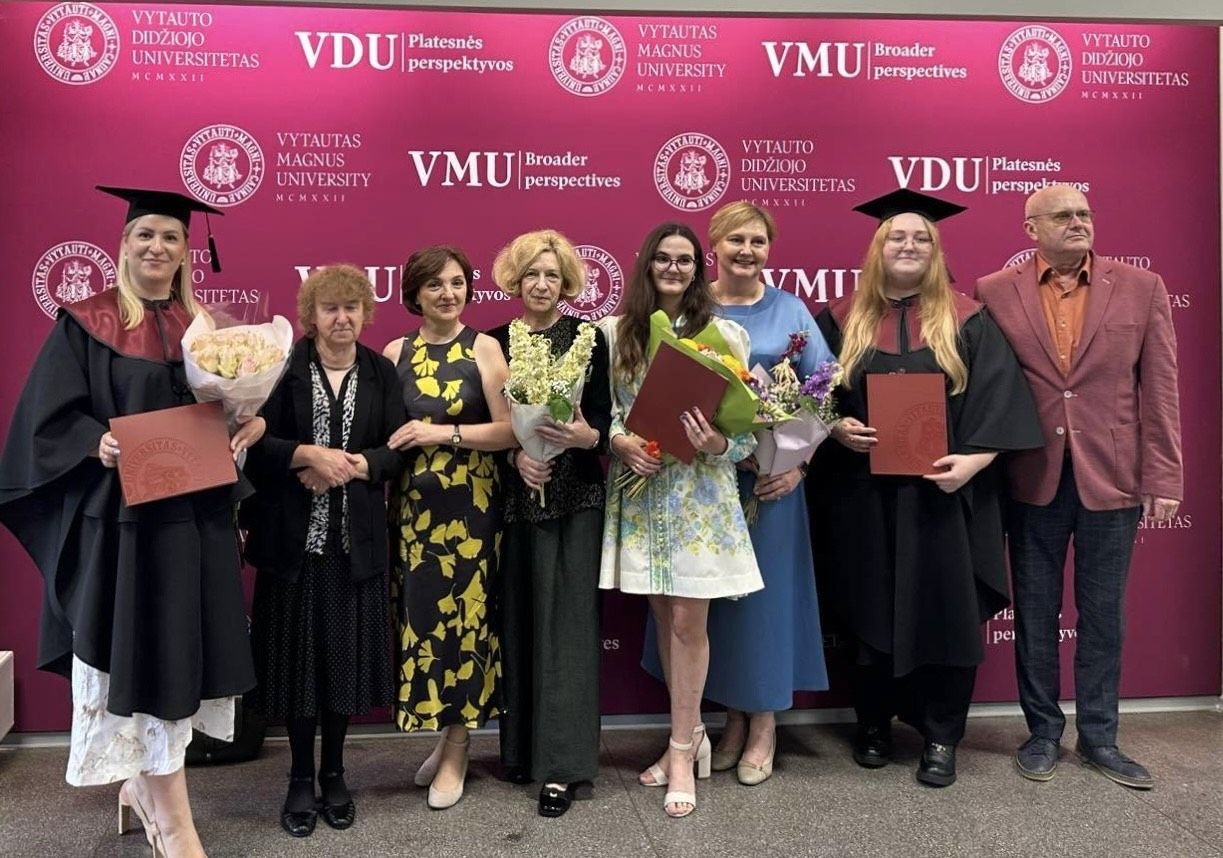
Thousands of pages of reading, years of practice and exams behind them
At the Vilnius Academy of Education of Vytautas Magnus University, diplomas were awarded to graduates of Polish Language Pedagogy. This year, four students received their bachelor’s degrees.
Teachers urgently needed
The small number of graduates highlights the broader issue of low interest in pedagogical studies in Lithuania. According to the Ministry of Education, last school year Lithuanian schools lacked about 650 specialists — mainly teachers of mathematics, Lithuanian and English, physics, chemistry, and biology. The situation is expected to remain similar in the coming academic year. Municipalities continue to search for educators, and schools regularly post job ads encouraging people to pursue a teaching career. As a result, nearly every new pedagogy graduate can find employment immediately.
Henryka Sokołowska: They will be ambitious, creative and inspiring teachers
As Dr. Henryka Sokołowska, head of the Centre for Polish Language and Culture at the Academy of Education of Vytautas Magnus University, explained in an interview with TVP Wilno, many more students had enrolled four years ago, but some dropped out along the way — some changed their plans, others realized it wasn’t for them.
— This year’s graduates are different in many ways, but what they share is strong motivation. Working with them was truly interesting — they proved themselves during internships, achieved a lot, and are ready to begin teaching. Without a doubt, they will become ambitious, creative, and inspiring educators — emphasized Dr. Henryka Sokołowska.
Training teachers for Polish schools in Vilnius
The history of training teachers for Polish schools in Lithuania dates back to 1961, when the Department of Polish Language and Literature was established at the Teacher Training Institute in Naujoji Vilnia. Seven years ago, the responsibility for preparing future Polish language teachers was taken over from the Vilnius Pedagogical University by the Centre for Polish Language and Culture in Vilnius, part of the Academy of Education at Vytautas Magnus University (VMU) in Kaunas. The Kaunas university’s branch is located in Vilnius, where future Polish language teachers can pursue their education.
— I’ve heard people say that our department no longer exists — perhaps because we are formally affiliated with a university in Kaunas. But it is here in Vilnius that we continue the education of future Polish language teachers — emphasizes Dr. Henryka Sokołowska.
She adds that applicants for Polish philology studies are typically highly motivated.
— Those who came to our “Academic Zone of Creative Polish Studies” — a series of workshops for Polish school students on topics like rhetoric, journalism, poetry and translation — made a very positive impression. However, most of them decided to study in Poland instead. We’re truly happy that they are doing well at Polish universities. Here in Lithuania, there are only a few Polish philology students — says Dr. Sokołowska.
Justyna Spranginaitė: I will miss these studies
Justyna Spranginaitė, this year’s graduate in Polish Language and Literature Pedagogy at the Academy of Education of Vytautas Magnus University, says she has always been fascinated by the teaching profession.
— I chose to study Polish because I’ve long wanted to teach in school. I was very inspired by my grandmother, who worked as a teacher for 40 years. It’s also thanks to the teachers and class tutor at my school — the Konstanty Parczewski Gymnasium in Nemenčinė — she points out.
Already in Their Second Year, Students Gained Practical School Experience
By the second year of their studies, students were already participating in internships at schools — initially observing classes, and in later years, testing themselves in the role of teachers.
— At first, the thought of leading a lesson on my own filled me with fear and anxiety, but over time, that fear disappeared, and I really began to enjoy working with students — says the pedagogy graduate.
She also highlights the positive atmosphere at the university.
— I’ll miss these studies because the atmosphere truly felt like family. Our lecturers constantly motivated and supported us in our learning. We had fascinating classes, gaining knowledge not only through lectures but also through hands-on workshops and educational trips, for example to Riga or Białystok — says Justyna.
— I will definitely remember my fellow students — not only from my year, but also from previous ones who still visit the university and with whom we maintain warm relationships — she adds.
The graduate also shares her future plans. She intends to work in a school.
— Right now, I’m in the process of looking for a job — she says.
Tatiana Malenowska: From Mickiewicz’s homeland to Polish Philology in Vilnius
Another Polish philology graduate from Vytautas Magnus University, Tatiana Malenowska, shares her story. She comes from Bieniakonie (now in Belarus), a place connected with Maryla Wereszczakówna — the beloved of Adam Mickiewicz — and, as she says, the region is steeped in romanticism.
— It’s well known that Mickiewicz was born in Nowogródek, but he often visited Maryla Wereszczakówna in Bolcieniki. In the churchyard cemetery in Bieniakonie lies his beloved’s final resting place — the Polish inscription is still visible on her gravestone — she explains.
Twelve years ago, Tatiana moved permanently to Lithuania and now holds a permanent residence card.
— I’m the mother of three daughters, aged 16, 13 and 9. During the COVID-19 period, I decided that I needed to change something in my life so that my girls could be proud of me. That’s when I also received a job offer at a kindergarten — Tatiana shares.
As is well known, Lithuania faces a shortage not only of school teachers but also of preschool educators. That’s why Tatiana didn’t hesitate — lacking formal pedagogical qualifications, she decided to begin her studies at Vytautas Magnus University.
— I have to admit, the beginning was very difficult because I first had to pass the national Lithuanian language exam. I already had a certified level of state language knowledge, but to be admitted to the university, I needed a high school graduation exam result. I took private lessons for three months, studied intensively, watched videos and read books. And I did it — I passed the exam, submitted my documents and got into my dream program — Tatiana recalls.
While studying, she also worked at the “Wilia” School-Kindergarten in Vilnius. She is very grateful to the principal for the opportunity to work and for her ongoing support.
— Honestly, when September comes and I no longer have to rush to university lectures, it will feel a little sad. I will miss the classes with Ms. Barbara Dwilewicz, Henryka Sokołowska, Halina Turkiewicz, Irena Masojć, Krystyna Syrnicka and Mr. Romuald Naruńce. I’ll miss them — she says.
Like Justyna, Tatiana also emphasizes the unique atmosphere of the Polish studies program.
— When I lived in Belarus, I studied law, and although it’s a different type of discipline, I can compare the two institutions. In Vilnius, I felt calm, like part of a family — the lecturers explained things patiently and helped us a lot. I truly appreciate that and talk about it openly with others — she assures.
— It’s no secret that Lithuania is facing a drastic shortage of teachers — whether in Polish, biology, or mathematics. I think choosing this profession is worth considering because teachers shape the future — ours and our children’s — she stresses.
That’s why Tatiana decided to continue her education with a master’s degree in pedagogy. She believes that through her work, she can have a real impact on the development of the younger generation.
A unique study offer: Polish plus English
As of 2024, Vytautas Magnus University (VMU) is offering an attractive new opportunity — a study program in Polish language pedagogy combined with a specialization in English.
— This combination gives good chances for employment — not only in schools — emphasizes Dr. Henryka Sokołowska.
Classes are held in Vilnius in full-time mode. During the course of their studies, students develop skills in two languages, so they can use their competencies after graduation either in education or in another professional field.
Translated by Klaudia Korona within the framework of a traineeship programme of the European Foundation of Human Rights, www.efhr.eu.